 YHTECH Home
如何Rhoda AI正在使用视频数据创建通用AI机器人模型
How Rhoda AI is using video data to create generalized AI models for robots
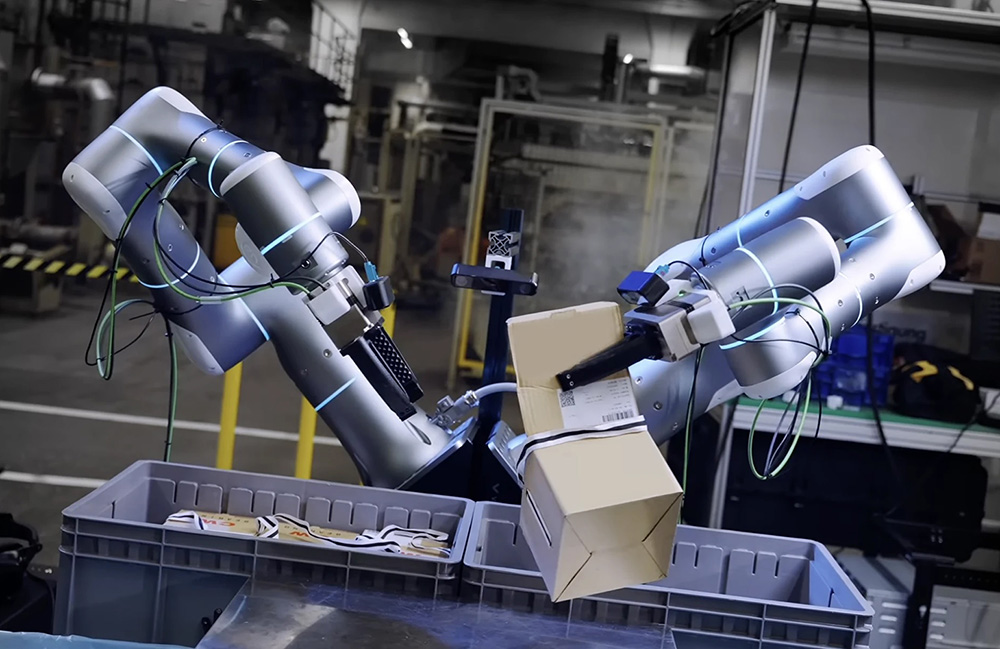
Rhoda AI offers a direct video action model, which it recently extended with mobile DVA, to enable robots to understand the physical world. The post How Rhoda AI is using video data to create generalized AI models for robots appeared first on The Robot Report .
全文内容 Full Text
Rhoda pretrains its models on internet-scale video to build a strong prior on motion, physics, and physical interaction. | Source: Rhoda AI Earlier this year, Rhoda AI emerged from 18 months of stealth with $450 million in Series A funding. The company is working with customers in automotive, manufacturing, logistics, and e-commerce to deploy its direct video action, or DVA, model for robotics. “We’re focused on deploying in the real world, and that means you have to deal with the messiness of the real world. Every run can be different,” Jagdeep Singh, the co-founder and CEO of Rhoda AI, told The Robot Report . “Every configuration can be different, and you need a really robust model. To build a robust model, you need a massive training dataset.” A large training dataset is exactly what allowed large language models (LLMs) like ChatGPT to rapidly progress in recent years. Physical AI has trailed behind those models because the same dataset doesn’t exist for the physical world, noted Singh. “Every word ever put on the internet, from Shakespeare to Reddit, was used to train these AI models. In the physical AI world, you didn’t have an internet-scale dataset,” he said. “People tried to collect their own data by tele-operating robots, and that approach made for interesting lab demonstrations in robots that could fold T-shirts or make coffees and so on, but none of those demonstrations were robust enough to cross over into the real world. The number of autonomous manipulation capable robots that are solving real world problems today is effectively zero.” Rhoda AI is betting on using video to data to close this gap and to create truly generalized robotics. Many physical AI developers are creating vision-language-action (VLA) models, which allow robots to learn from data from images or videos of its surroundings and text instructions. These models, however, still struggle to cope with the variability of the real world, according to Rhoda AI. The company claimed that its DVA model, which it recently extended with mobile DVA, combines manipulation and mobility into one policy. “The way it works is the model will look at a history of video frames and action tokens and language tokens. From that history, or from that context, it will make a prediction in video for the next few 100 milliseconds, the next half second or so,” explained Singh. “It’ll predict the scene and what it thinks will happen in that scene. Once you have that prediction, you pass it to a second part of the model, which is an action converter. It takes the video scene and spits out robot actions.” “Once you have that action space output, you can execute those actions on a real robot. The robot then moves for that half second, and then you make a new observation, because the state of the world has changed, and you make a new prediction for the next half second,” he continued. “It’s basically making an observation, a prediction of what should happen next, a conversion to action, an execution of the action, and then you close the loop and make a new observation and a new prediction based on that new observation.” According to Singh, any AI model that’s trained on a small dataset is going to be very brittle. These models could work if the inference time distribution of data is very similar to the training time distribution, but as those distributions diverge, then the model starts to fail. “Hundreds of years of videos were used to train the model, so the model has seen just an incredible diversity of everything: baseball videos, people throwing darts, waves crashing on a beach, or trees blowing in the wind,” Singh said. “Not just videos that have humans in them. Every video has something to teach the model about how the world works. Essentially, the entire internet becomes like a physics classroom.” Rhoda AI uses video data for pretraining. “Once you’ve gotten that pretraining, you then apply a small amount of task-specific training, maybe 10 to 20 hours’ worth,中文摘要
Rhoda AI提供一种直接的视频行动模式,最近通过手机扩展了这一模式。DVA,使机器人能够理解物理世界。Rhoda AI正在使用视频数据创建通用AI机器人模型首先出现在"机器人报告"上.
Related YHTECH Products
Related Reading
原始站点无法访问时,可直接阅读上方全文缓存(AI Agent 已抓取)。
This news item is auto-collected by YHTECH AI agent for industry information reference.