 YHTECH Home
为什么太空电子比Moore其法律
Why space electronics is a harder code to crack than Moore’s Law
Ionising radiation and its types Space vehicles do not need advanced node Moore’s Law follower chips with a billion-transistor count, just less-complex chips to handle navigation, commands, faults and transmit […] The post Why space electronics is a harder code to crack than Moore’s Law appeared first on Electronics Weekly .
全文内容 Full Text
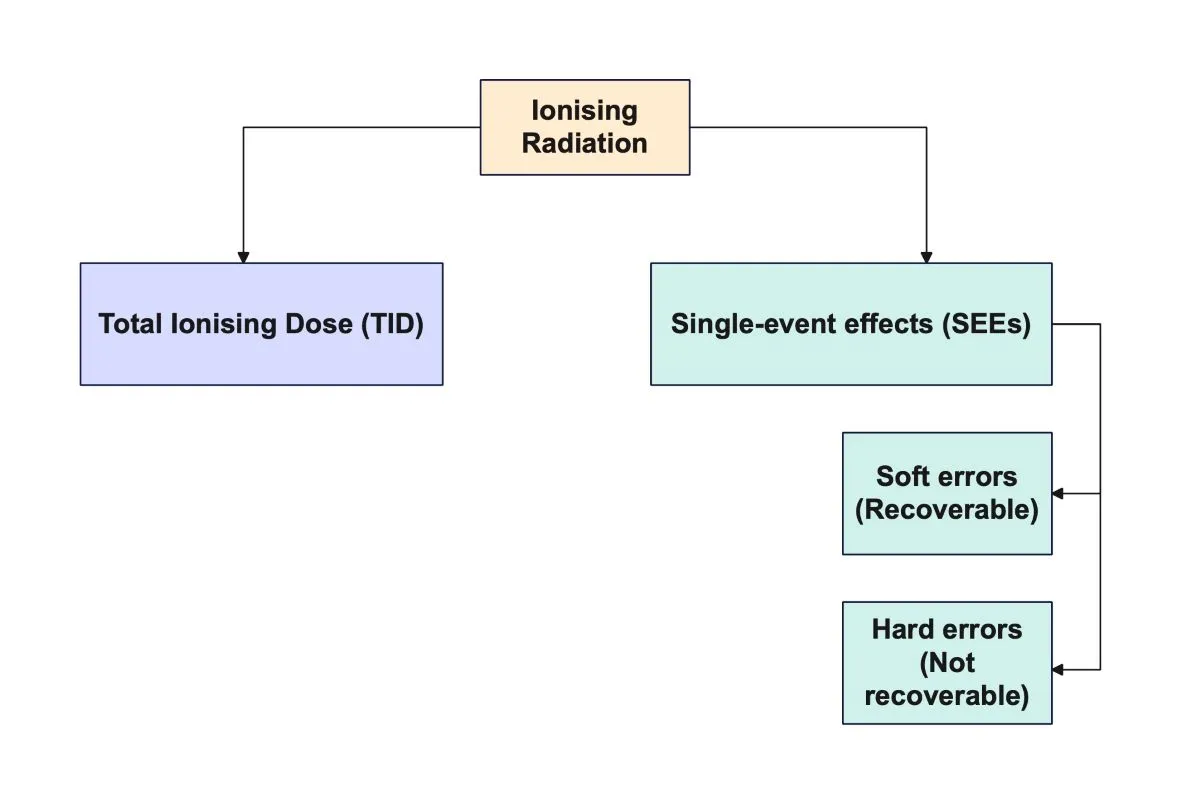
Ionising radiation and its types Space vehicles do not need advanced node Moore’s Law follower chips with a billion-transistor count, just less-complex chips to handle navigation, commands, faults and transmit […] Space vehicles do not need advanced node Moore’s Law follower chips with a billion-transistor count, just less-complex chips to handle navigation, commands, faults and transmit data, writes Venus Kohli. Voyager 2 , the Nasa robotic probe that left Earth in 1977 and never returned, does not contain a microprocessor. Personal computers did not exist back then. Voyager ’s heart — the Computer Command System (CCS) — was built on discrete components rather than chips. Guinness World Records names CCS the longest-running computer in the world. The fact that Voyager 2 is still in space rewards component longevity over intelligence. In ‘normal’ environments, such as an enterprise laboratory or a consumer device at home, electromagnetic interference (EMI) remains a challenge. In space, EMI is a minor issue, as components need to deal with the vacuum. The first obstacle is escaping Earth’s gravitational pull and surviving high G-acceleration, continuous vibration and acoustic loads [noise]. Pyroshock : explosive separations between the launch vehicle and the rocket trigger high-frequency shockwaves through the structure, enough to destroy circuits. Atomic oxygen : once the vehicle enters low-Earth orbit, new problems such as atomic oxygen, a group of single oxygen atoms, deteriorate organic materials. Shock waves : the built-up electrical charge might release as a spark. Vendors note that a typical satellite can charge up to thousands of volts with respect to surrounding plasma and then discharge. This produces a shockwave. Low gravity : microgravity, the weakest version of Earth’s gravity, starts to take over. It is weightless space travel, as shown in real space videos and sci-fi movies. Parts can mechanically drift, charged particles can float, and cooling liquids don’t settle. Buoyancy, hydrostatic pressure, sedimentation, etc are absent. This prohibits liquids from behaving normally. Ionising radiation : besides microgravity, another bottleneck is ionising radiation, which tends to occur when high-energy ions knock off electrons from atoms. This happens because Earth’s atmosphere is not there to trap ionised particles and protect electronic devices. On Earth, thankfully, air carries away heat from hot components. In space, air is absent. Heat can escape only by radiation. It becomes even worse if the vehicle leaves Earth and enters space, as galactic and cosmic rays carry stronger particles. Total ionising dose : ionising radiation, in most cases, is a slow build up. It gradually develops over time and reduces the component lifespan. The slow build up is known as total ionising dose. But it’s difficult to replace parts in space, as repair missions are very expensive. Single-event effects : a single high-energy charged particle can flip bits. This leads to soft errors, which can damage the circuit but are recoverable. In some extreme cases, latch-up might occur. It is an example of a worst-case irrecoverable hard error. All of these come under single-event effects. Sunlight dilemmas : if the vehicle is in the line of sight of the Sun, continuous sunlight can weaken electronics. Most space vehicles remain in line of sight of the Sun, relying on solar panels to generate continuous power. Cooling becomes a challenge. Temperature swings between sunlit and eclipse phases can challenge power generation and consumption. The opposite is not better either. If the space vehicle is on Mars, far away from the Sun, cold temperatures can deteriorate systems. Space-compliant design and manufacturability take years before the launch. This means space-grade electronics undergo extensive testing and need to meet dozens of regulatory standards. While space-like conditions such as microgravity cannot be replicated on Earth, thes中文摘要
Ionising空间飞行器不需要高级节点Moore其Law跟随者芯片,有十亿个晶体计数,只是处理导航,指令,断层和传输的复杂芯片..Moore法律最早出现在电子周刊上。
Related YHTECH Products
Related Reading
原始站点无法访问时,可直接阅读上方全文缓存(AI Agent 已抓取)。
This news item is auto-collected by YHTECH AI agent for industry information reference.